


Catholic Medical Quartery Vol 76 (1) February 2026
Book Review
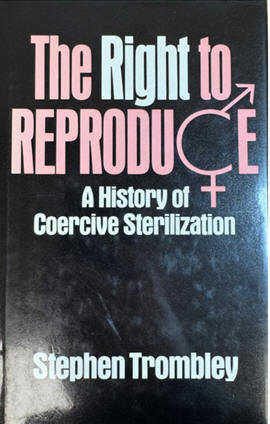
The right to reproduce: a history of coercive sterilisation
by Stephen Trombley
Wiedenfeld and Nicolson: Published 1988
and
subsequently withdrawn from publication for legal reasons.
Reviewed by
Dr Peter Doherty in 1989 and reproduced here
 Unfitness
is hereditary and good citizens have a right to promote the reproduction
of fit stock and discourage or prevent the reproduction of the unfit. Such
was the aim of the Eugenics Education Society founded in 1907 by Sir
Francis Galton and later to be known simply as the Eugenics Society. As it
progressed the assertion was made that 25% of the population produced 50%
of the nation's children. Dr. Marie Stopes a pillar of the Eugenics
movement wrote in 1920 that "Utopia could be achieved in my lifetime
had I the power to issue inviolable edicts".
She wanted legislation which would enable the compulsory sterilisation,
not only of the insane and feeble minded, but of 'revolutionaries',
'half-castes', the deaf, the dumb, the blind and anyone who might threaten
the vigour of the race. In 1920 she proclaimed in the Sunday Chronicle
that "racially all diseased and inferior men were superfluous".
Unfitness
is hereditary and good citizens have a right to promote the reproduction
of fit stock and discourage or prevent the reproduction of the unfit. Such
was the aim of the Eugenics Education Society founded in 1907 by Sir
Francis Galton and later to be known simply as the Eugenics Society. As it
progressed the assertion was made that 25% of the population produced 50%
of the nation's children. Dr. Marie Stopes a pillar of the Eugenics
movement wrote in 1920 that "Utopia could be achieved in my lifetime
had I the power to issue inviolable edicts".
She wanted legislation which would enable the compulsory sterilisation,
not only of the insane and feeble minded, but of 'revolutionaries',
'half-castes', the deaf, the dumb, the blind and anyone who might threaten
the vigour of the race. In 1920 she proclaimed in the Sunday Chronicle
that "racially all diseased and inferior men were superfluous".
Sidney Webb and other Fabian Socialists were worried by the differential birthrate. For him it appeared
"In Great Britain at this moment (1907) when half or perhaps two thirds of all the married people are regulating their families, children are being freely born to the Irish Roman Catholics and the Polish, Russian and German Jews on the one hand, and to the thriftless and irresponsible - largely the casual labourers and other denizens of our great cities - on the other. This can hardly result in anything but national deterioration; or as an alternative in this country gradually falling to the Irish and the Jews".
Such a chilling prospect was not confined to the Eugenics Society, as Stephen Trombley masterfully portrays. In a presidential address to the Royal Sanitary Institute in 1912, the moderate Archbishop of York said that the national stock was deteriorating and steps were required to prevent the breeding of feeble-minded, abnormal, insane, criminal and diseased persons. Even after the Holocaust in Nazi Germany, Dr. Edwards Barnes, Bishop of Birmingham told the Birmingham Rotary Club (28th November 1949) of his plan for post-war social reorganisation. The bishop was critical of the new Welfare State because he believed it would foster undesirable tendencies.
A Times reporter summarised his speech thus
“A time was coming when sterilisation of the unfit would be essential to Britain's social organisation and might well be the complement of the Welfare State".
To mention the Holocaust is to reveal the strange association with which the Eugenics Society became involved. At the launch of its Quarterly Journal The Eugenics Review, (1909) Stephen Trombley notes that fraternal greetings were offered in a special contribution by the German Eugenist, Alfred Ploetz which caused the Editor to claim that “Eugenics will bring a new blessing to mankind, for it will prove to be a harbinger and handmaid of Peace".
Ploetz and his colleague, the internationally renowned psychiatrist Dr. Ernst Rudin, were chosen by Hitler as architects of the Final Solution, either through the early practice of sterilisation or the later practice of Euthanasia and Genocide.
From the Nazi Sterilisation Law of 1933 to the outbreak of the war in 1939 the journal and the Society solicited articles and speakers from the ranks of German Eugenists. A dominant feature of this study is the progress the Eugenic Movement had made in the years before 1939 in both Europe and America. Many of the Nazi principles were adopted from those current in other countries.
For Trombley voluntary sterilisation is a decision usually taken in the context of an established relationship in which the partners have had the desired number of children and wish in future to practice a permanent form of contraception.
Coercive sterilisation on the other hand involves deception, undue pressure, threats or violation of the principle of informed consent. It represents yet another area in which medicine claims for itself the right to interfere in the most intimate aspects of life.
It is unlikely that the early campaigners would receive much credence today in the developed countries, with their emphasis on the societal role of sterilisation. The debate is now strongly fixed on the individual, usually the mentally retarded. Trombley points out the ultimate absurdity of this position by referring to the Brock Report commissioned in 1932 by the then Minister of Health, Sir Hilton Young, to examine the problem of mental deficiency and the sterilisation solution. It recommended that "The right to sterilisation should be extended to all persons whose family history gives reasonable grounds for believing that they may transmit mental disorder or defect."
According to the Committee's calculations, this would include 3.5 million people.
The history takes us up to the present day, from the two prominent proponents of sterilisation in the 1970's Sir Keith Joseph and Dr. David Owen, to the famous judgement of Mrs. Justice Heilbron in 1975 disallowing a sterilisation operation. That feeling has changed since then is evident from the Appeal Court judgement (3 February 1989) recently confirmed in the House of Lords (4th May 1989).
Their Lordships decided that an operation for the sterilisation of an adult mental patient, who by reason of her incapacity was unable to give her consent, could be proceeded with. It is presumed, that as informed consent is not fully possible in these circumstances, sterilisation may be undertaken as being in the best interest of the subject. An alternative view, in this case, might be, that as there was no evidence of rape a degree of consent must have been present before she engaged in sexual relationships with a fellow patient and her "best interest" might not always be served by sterilisation. Although the risk of unwanted pregnancy may be removed, the dangers of venereal disease or Aids become more possible. This is an important study and is extremely well researched. Its concluding paragraph aptly sums up the whole argument:
"As a political, social, or medical expedient, coercive and compulsory sterilisations do not exist, and never have Branches of the Guild existed, for the benefit of the victims. Rather they exist in order to relieve theimagined burden of the fertility of the unfit on those around them, parents, teachers, social workers, heads of institutions, the medical profession, the State".
Reference
- Peter Doherty1989 Catholic Medical Quarterly Vol. 40 No. 3 (243). August 1989 pp157-160