


Catholic Medical Quarterly Volume 75(4) November 2025
Book review.
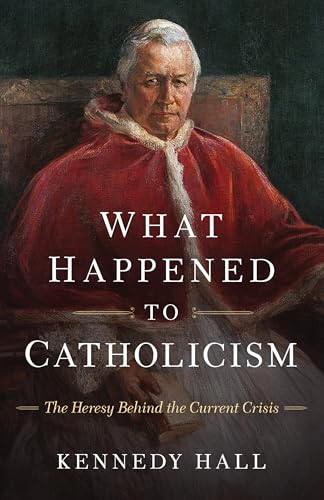
What Happened To Catholicism?
The Heresy
Behind the Current Crisis
by Kennedy Hall.
Sophia Institute Press
Reviewed by Dr Pravin
Thevasathan
 A great and easy read. The heresy is, of course, Modernism. It was
condemned by Pope St Pius X over a hundred years ago but it is alive and
kicking inside the Church.
A great and easy read. The heresy is, of course, Modernism. It was
condemned by Pope St Pius X over a hundred years ago but it is alive and
kicking inside the Church.
I was particularly interested in the philosophical roots underpinning the Modernist heresy. The author begins with William of Ockham. He was a nominalist who denied that the human intellect can apprehend universal concepts. The essence of a thing cannot be known. We cannot know the essence of a dog. All we know is external dog-like qualities. Thus everything outside the mind is individual and subjective. For the Aristotelian, a thing is known by its essence. When a Nominalist says: "look at the beautiful flower," all he is saying is "look at those things that appear to have the characteristic of flowers and beauty. I perceive them to be flowers because they look at other things I perceive to be flowers. If the essence of a thing cannot be known, there is always doubt. Ultimately this leads to the Modernist view that if it feels right, then it must be right...at least for you. All is subjective.
As a result of Nominalism, we have what the author refers to as the four horsemen in the history of philosophy: Descartes, Kant, Hegel, and Hume. For Descartes, because I think, I must exist. The Subject is the centre. All is subjective.
In contrast, knowledge in the Aristotelian tradition begins with the sense. Hume did believe that knowledge is received from the external senses. But, like Ockham, he believed that knowledge received from the external senses is merely an image of what is presented by the object. The "supersensible" is unknowable. Once again, there is doubt.
Like Hume, Kant accepted the existence of a physical world. But he also believed we impose categories on our sensory data. The real nature of external things is unknowable. Thus Kant follows Ockham and Hume. Because reason cannot be trusted, it is possible for us to believe in contradictory things. This leads to scepticism. If I am sceptical about knowing the outside world, I cannot be led to a belief in God by means of the world outside. Al I have is what I feel inside: I feel that God must exist. This is the "Vital Immanence" of the Modernists. What Ronald Knox referred to as a FIF: funny interior feeling.
Hegel followed Kant but argued that noumenal reality can be known but is an ever-active process in which reality goes back and forth between itself and its opposite in order to produce a higher reality.
To put it simply, all these recent philosophical traditions lead to subjectivism and doubt. The only good alternative is a return to Aristotle