


Catholic Medical Quarterly Vol 76 (3) August 2026
Book Review.
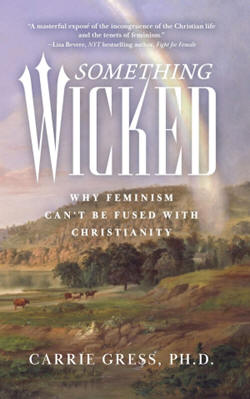
Something Wicked: Why Feminism Can't Be Fused With
Christianity
by Carrie Gress
Sophia Institute Press
 I was
under the assumption that the feminist movement was campaigning for
women's dignity until the sixties. It then moved on to promote a more
secularist agenda including abortion rights. The author of this brilliant
work has convinced me otherwise: there was something rotten in the
feminist movement from the very beginning.
I was
under the assumption that the feminist movement was campaigning for
women's dignity until the sixties. It then moved on to promote a more
secularist agenda including abortion rights. The author of this brilliant
work has convinced me otherwise: there was something rotten in the
feminist movement from the very beginning.
Gress shows us that Christianity has promoted the dignity of women. Prior to it, polygamy reigned. In contrast, Christianity ensured that the love of one man for one woman became the basic cell of civilisation.
One of the early feminists, Mary Wollstonecraft (1759-1797) became a feminist in good measure because of abusive or negligent men, beginning with her own father. She was influenced by utilitarians and anarchists. She married an anarchist, William Godwin. She mingled with men who supported Rousseau and the French Revolution. For her, the Christian past represented superstition, oppression, and ignorance. After her untimely death, Godwin published her biography, describing her radicalism, her affairs, and her suicide attempts. For her, religion and reason were incompatible. Gress compares Wollstonecraft to Hannah More (1745-1833), a committed Christian who believed that the dignity of women is achieved by serving others. More often reminded women of the importance of motherhood.
The followers of Wollstonecraft followed her lead. Frances Wright abandoned Christianity for atheism, as did Susan B. Anthony and Lucretia Mott. Elizabeth Cady Stanton became a spiritualist. They all hated Christianity. Frances Wright became the mistress of the Marquis de Lafayette and established a community practicing "free love." She campaigned to have Christianity abolished. Lucretia Mott condemned any kind of Church hierarchy. Yet another early feminist, Matilda Gage, attacked Christianity.
From 1868 to 1872, Susan B. Anthony and Elizabeth Cady Stanton ran a newspaper called "The Revolution." Its aim was simple: to tear apart the existing social fabric. These feminists saw Christianity as a tool used by men to enslave women. Instead, they embraced Karl Marx. The Pankhursts were involved with the International Communist Party. American feminists who belonged to the Heterodoxy Club wanted to change society by belittling Christian orthodoxy. For Charlotte Gilman, motherhood made it impossible for women to achieve their potential. She compared marriage to prostitution. For Margaret Sanger, birth control was essential for the new woman.
Simone de Beauvoir also believed that women needed to be freed from male dominance. She abandoned Catholicism, only to be dominated by Sartre.
Gress notes that so many feminists had unhappy childhoods and unhappy marriages.
This is an important work: the author provides us with a great deal of evidence to show that Christianity and feminism are incompatible.